
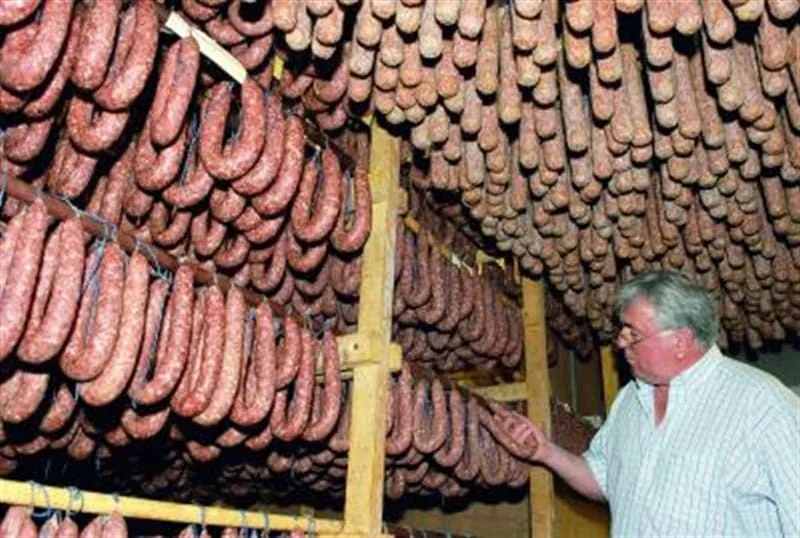
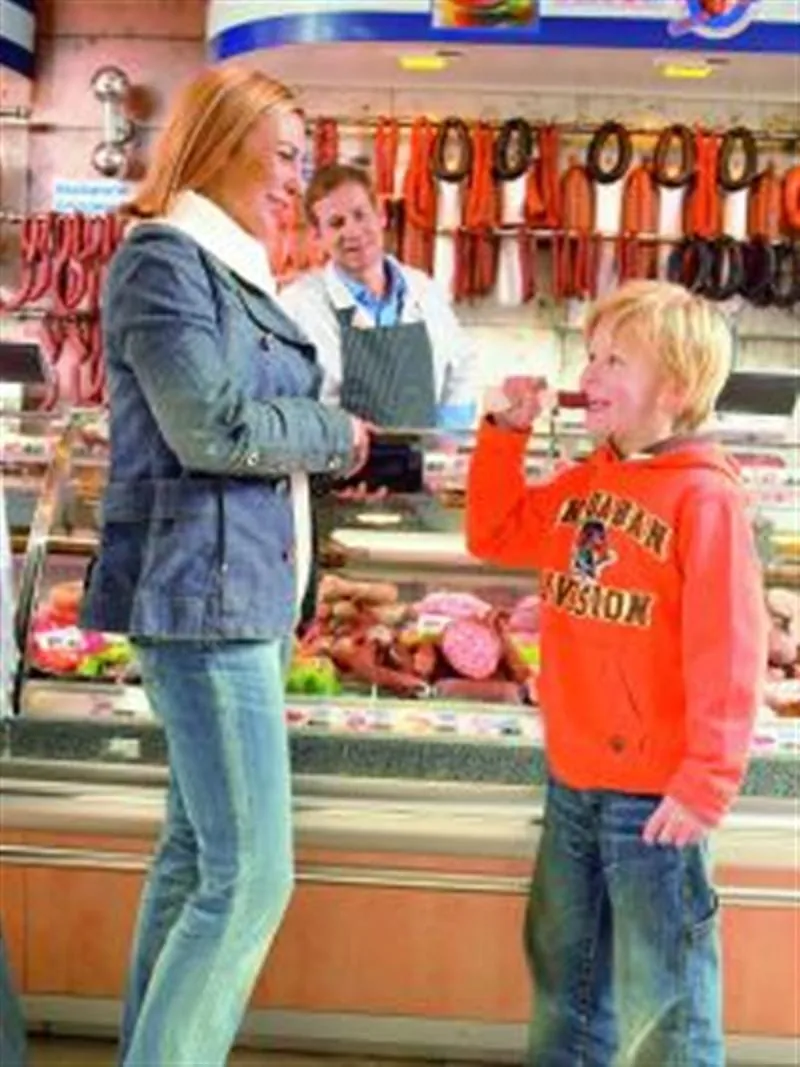
Almost half of all sausage varieties manufactured in Germany are stuffed into natural casings. Consumers equate such a natural wrap with the idea of craftsmanship in sausage production, and with a high quality standard of the finished product. An image which produces a good sales promoting effect – particularly for meat specialty stores.
The authentic casing
◆As old as sausage manufacturing itself: the use of natural casings. When it comes to sausage specialties of craftsmanship-typical quality, butchers tend to fall back on time-tested manufacturing practices, sometimes also including recipes that have been there for centuries. No wonder that many sausage preparations date back to the Middle Ages. It is in particular in monasteries and nunneries where these recipes were developed by nuns and monks who stuffed lamb, beef and pig casings in order to have long keepable supplies on hand during cold winters.
In the trend of times
While internationally operating companies are opening up more and more markets, distributing their products under the same brand names everywhere, globalization is increasingly arousing consumers’ yearning for transparent, “as natural” and craft-rooted manufacturing processes. With the consequence that regionally rooted products are seen as synonymous with good quality and, as a result, viewed as particularly trustworthy.
It follows that, according to a market survey by ZMP (Germany’s Bonn-based Central Market and Price Reporting Agency) about three quarters of the population would like to see more products from their own area. As such, a region known to consumers takes on the role of not only guaranteeing good quality, but good taste as well. This trend is positively reinforced by German consumers’ return to a more quality-conscious shopping behaviour. At the same time, consumers are also increasingly looking out for foodstuffs with a natural appeal – not least because purchasing meat and meat products has increasingly become a question of trust. Checking in as one good example is the natural sausage enveloping. A representative study of shopping behavior, conducted by the Nuremberg, Germany-based GfK (German Consumer Research Society) shows, for example, that sausage in natural casing enjoys a particular positive image: more than half of all consumers would prefer sausage products in such a natural casing even if they would cost 10 percent more. And 64 percent of consumers surveyed even emphasized that, when shopping for food, their mindset was more on quality than on price.
Natural casing figures on the bottom line
But it is not only the well-known product advantages that are making a case for natural casings, but purely business-efficiency related reasons check in as well because, thanks to shoppers’ high-level appreciation on the one hand, and the fact that processing of these casings has been enormously facilitated over the last few years on the other, sausages in natural casings have become enormous sales builders for a great number of companies. Numerous new developments on the part of natural casings manufacturers have also come into play, further improving natural casings’ handling aptitude. To wit, ready-to-fill casings are offered in bags and cans, packed in salt brine as ready-to-use long loops. From a purely business-profitability point of view, the natural casing figures for itself. While some varieties, such as narrow beef casings for example, are anyway offered at a price lower than that charged for artificial wraps, is not lastly the natural product’s weight advantage that allows for charging a higher sales price and thereby higher profits.
Stringent impositions
For any type of sausage, there is a suitable casing that fits – where one with specific properties, such as optimum curing and smoke acceptance as well as product adhesion – lends itself to be used with any individual sausage variety in a particularly advantageous manner. But long before natural casings are processed in actual sausage manufacture do they become subject to a series of quality and hygiene or sanitation checks and controls. As one example, imported casings are subject to an examination following stringent EU standards. In addition, sorting and further improving natural casings may only be carried out by specifically trained personnel in officially licensed processing plants. The final step in refinement and further processing comes in the form of the natural casings being sorted and placed in a flawless package. With the development and practical application of modern quality management systems and HACCP concepts, natural casings manufacturers are translating these requirements into practice.