
Many types of artificial casings are available. Additional functions such as smoke or spice transfer simplify production processes for butchers. This article discusses how mold growth on the outer side of plastic casings can be suppressed through the use of auxiliary substances.
For many foods such as meats, sausages and cheeses, casings play an important role. They are used to form them, as a production aid, as protection against environmental influences (light, air or moisture) or flavor loss, against contamination by microorganisms and foreign bodies, damage and soiling and last but not least, as a promotional and information medium.
Meanwhile, artificial sausage casings now frequently come with additional features such as the transfer of smoke or spices. The Walsroder casing shows how a technical auxiliary on the outside of a raw or semi-dry sausage casing can suppress mold growth.
For over 85 years, the company has manufactured artificial casings for sausage products. The casing has always been used to form the sausage into the desired classical shape. As technological new developments from Walsroder show, there can be more to it than that. After all, artificial casings can do more than just give form to a sausage. The basic idea is as simple as it is convincing. The casing producer coats the inner side of the casing with additives that ensure the desired properties, improve the sausage production process, save costs and prevent loss.
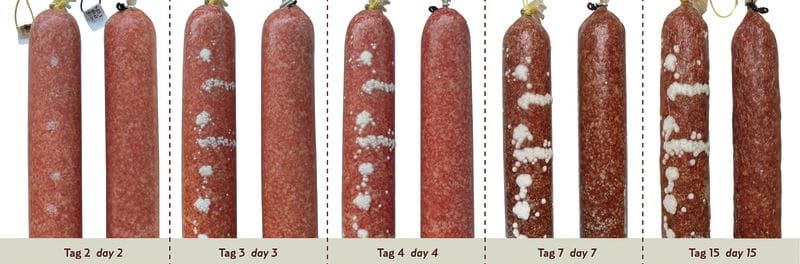
The BFU Walsroder fiber casing is an innovation now mature enough for the market and equipped with a special feature: “bio-agents” that fight mold. “BFU” stands for “biofungistatic”. BFU casings feature a completely safe auxiliary substance that suppresses the growth of undesirable mold on the casing exterior.
The product has been successfully introduced on the market. According to the manufacturer, the solution uses plant-based raw materials and is an effective and sustainable solution that greatly benefits small sausage-producing companies as well as consumers when it comes to hygiene and food safety.
Food safety is coming more and more into focus when it comes to the production, storage, sale and consumption of sausage products. In this regard, hygiene and the prevention of unwanted bacteria are central.
To distinguish themselves from large industrial companies, smaller companies want to show off their know-how through the high quality of their air- and mold-cured raw sausages on the one hand. On the other hand, however, they also want to reduce or even completely avoid the use of additives, smoking or intensive washing to keep bacteria such as undesirable mold under control. And especially in smaller companies, due to space and cost constraints, mold-cured and non-mold-cured raw sausages are often produced adjacent to each other, without adequate microbiologically effective separation. The transfer of unwanted germs such as mold and yeast is hardly preventable – or can only be achieved with considerable manual and chemical means – which are then subject to declaration.
Effective function on the exterior
This problem was the starting point for the intensive search for an innovative and safe solution for preventing mold growth on sausage casings.
In the manufacture of the Walsroder BFU (cellulose) fiber casing, a patented technological auxiliary is applied to the outside of the casing – that is, the side facing away from the sausage material. Very small quantities of this substance are sufficient, so that no oily surfaces arise. The active substances are affixed to the fiber casing surface in such a way that sufficient quantities are still present after the usual soaking procedure. Reducing germ growth extends the shelf life of the unfilled casings.
BFU fiber casings are typically used for raw sausage such as salami. In practical testing, the growth of undesirable mold is suppressed. The product is effective against a variety of molds (including Penicillium nalgiovense) as well as against yeasts (such as Debaryomyces hansenii). Walsroder’s tests have also been positive for semi-dry products and packaged raw sausage. Mold growth is suppressed, but not completely and permanently excluded. Basic hygiene measures must still be practiced.
BFU sausage casings are processed just like any other conventional fiber casings: soaking, plump filling, closing and manufacturing the raw sausage as usual. The adhesion of the casing to the filling is in no way negatively influenced.
Completely safe and declaration-free
It should be emphasized that the effective, active substances are not based on metal or chlorine compounds, but on plant-based spice oil extracts. These active substances can in principle be used as food additives. The technological auxiliaries comply with German and European directives (LFGB, EU) and are considered as GRAS (Generally Recognized As Safe) in accordance with US directives (FDA).
Because these technological auxiliaries do not affect the sausage nor influence its microflora, appearance, feel or pH value, they do not need to be declared on the list of sausage ingredients. In April 2014, the independent Gissel Institute confirmed the marketability of raw sausages made with these casings. In addition, their conformity was confirmed by the Isega Institute on June 23, 2014. The products are kosher.
In the subsequent article, Die Fleischerei presents artificial casings made by other manufacturers, some of which also feature additional functionality.