
With 3,273 exhibitors from 98 nations and over 51,500 trade visitors from 143 countries, the four-day BioFach trade fair in Nuremberg in February set new exhibitor and visitor records. NürnbergMesse counted 93 meat and sausage exhibitors, 43 of whom came from Germany.
Lectures given by experts at the congress focused on how ecological aspects can be complied with, from plant cultivation and animal breeding to farming, processing, packaging and preparation. The focus in 2019 was “System Bio – Overall Healthy”. The food trends “high-protein” and “sugar-free” could be seen overall, just as could gourmet oils, algae and fermented products.
Silver for Isartaler Leberkäse
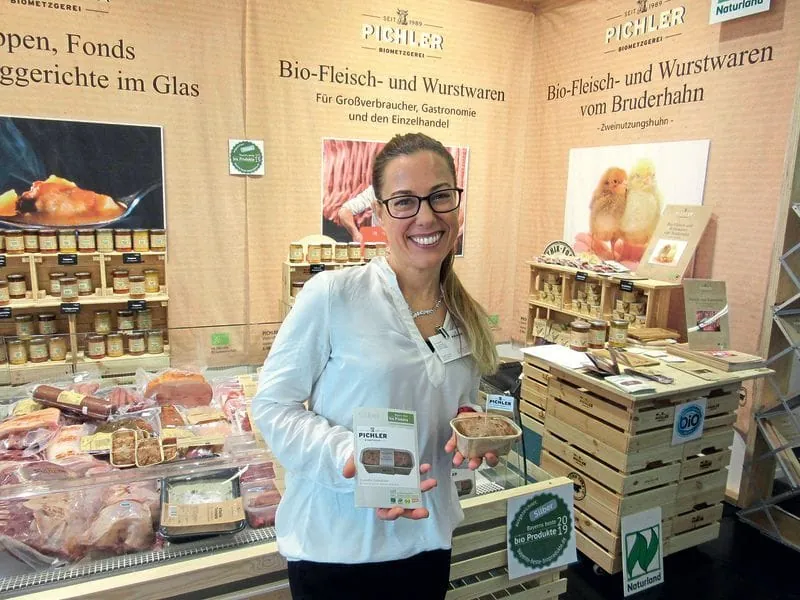
“Leberkäse must taste good; that is the most important thing,” finds the Pichler organic butcher shop from Gräfelfing; it offers its Isartaler Leberkäse in Naturland and Bioland quality in 500 and 150-gram baking forms. They consist of 100 percent unbleached, FSC-certified paper, are free of adhesives and plastics and completely biodegradable. Although the forms can withstand temperatures of up to 220 degrees Celsius, Eva Klotz, the personnel manager and animal welfare officer, recommends baking the small loaves of Leberkäse at 120 degrees Celsius for 15 minutes. Also completely degradable is the transparent film based on plant starch that protects the product at the self-service counter. An easily removable recyclable paper sleeve contains the declaration. At the International Green Week in Berlin this past January, Pichler’s Isartaler Leberkäse received a Silver Award as one of Bavaria’s best organic products.
Utilizing the whole animal
Pichler had already won a Gold Award in 2018 for its smoked chicken-herb-spice hard sausages, made from chicken and beef. The family business, which has been awarded the Ethikfood certificate, attaches particular importance to animal welfare and has been committed to the rearing of male chicks for many years. The meat is processed into sausage. It’s hard to sell as is, Eva Klotz knows. It is darker, firmer and takes longer to cook than the usual meat. At first, the restless behavior of the young cocks caused some problems in the hatchery. This problem has been solved now. In addition to the hard sausages, the company also produces boiling sausages from the meat of the male chicks. New in the assortment is a meat sausage with paprika. Also new are three types of dog food in 370 g jars that are recommended as either sole or supplementary food for adult dogs. They are produced by Edenfood GmbH in Gauting, a manufacturer of organic dog and cat food. “We want to utilize the whole animal,” explains Eva Klotz. The company promises transparency from animal to consumer. Many of its over 100 meat and sausage products bear the Bavarian Bio-Seal.
Regionality with seal
Since 2015, the Bavarian State Ministry of Food, Agriculture and Forestry has been awarding a bio-seal for organic foods made from regional raw materials that meet the legal organic quality requirements specified by Bavarian organic farming associations. The goal is a transparent, seamless value chain. Short delivery routes, regional economic cycles and domestic cultural and agricultural activities are promoted. A state-approved control system guarantees compliance with the criteria. Currently, around 1,200 products from 150 manufacturers are labeled. One is Altdorfer Biofleisch GmbH from Altdorf near Landshut, which has the seal for its white sausage, and Kathi’s-Bio-Wurst. Kathi’s Bio in Naturland quality is produced exclusively for sales in butcher shops.
Participation in the Bavarian Organic Seal Quality Program is open to all regions in European Union member states, to companies in the agricultural and food industries, and to retailers in the food sector in the European Union. The color and indication of origin on the logo vary with the region or country, but the lettering of the Bavarian State Ministry as the awarding authority remains unchanged.
Focus on climate
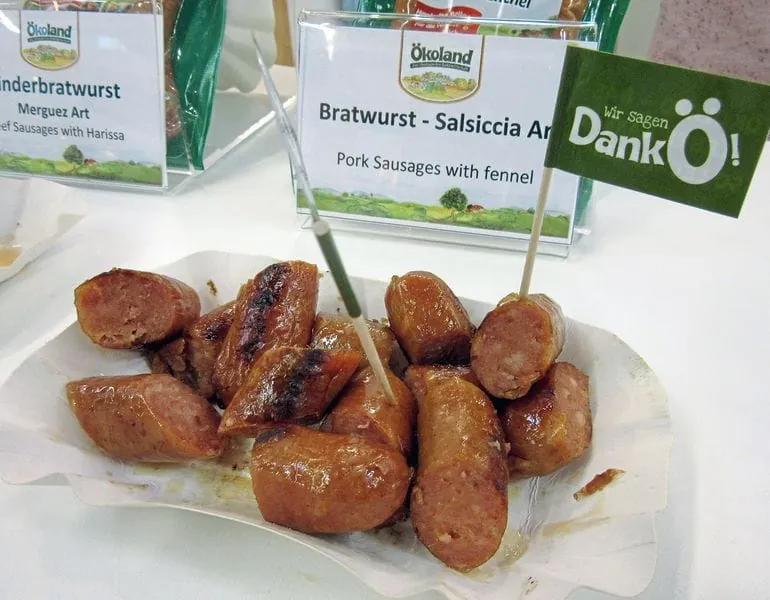
At least this is true for Ökoland GmbH Nord – and has been for over 25 years. Since 1991, the company from Wunstorf has constantly worked on improving its sausage products and expanding its product range. Ökoland GmbH particularly focuses on climate-friendly production. In 2008, it launched the first climate-neutral bratwurst. The “Superwurst” was and is certified according to the Stop-Climate-Change-Standard (SCC-Standard). Since then, the entire company has been certified accordingly – including its bratwurst and a cooling bag. Ökoland GmbH operates an energy-efficient office building. In the slaughterhouse, 80 percent of greenhouse gas emissions have been reduced, among other things by solar energy and green electricity.
The company claims to offset unavoidable emissions by investing in energy-efficient and low-smoking stoves in Africa. Among other things, Ökoland GmbH is socially involved as a cooperation partner of SOS-Kinderdorf e.V., supports the BioBrotBox campaign, the Clinic Clowns and, more recently, initiatives that support women and children refugees.
Salamis from biosphere reserve
No meat lover can pass by the counter of the Bäuerliche Erzeugergemeinschaft Schwäbisch Hall (BESH). Behind the glass pane, the meat of the Schwäbisch Hällischen Qualitätsschweine g.g.A. looks pink and juicy. BESH also presented its new range of salami and ham, which ripen in the unpolluted Rhön mountain air for up to 18 months. The manufactory is located in the middle of the Hoch-Rhön UNESCO Biosphere Reserve at an altitude of over 800 meters. It has been proven that this area has the purest air in Germany.
All hams and salamis are produced without additives and only with natural spices from ecological partnership projects in Zanzibar, Serbia and India. The top product is the acorn-fed ham from the Schwäbisch Hällischen Landschwein, which is matured on the bone for 18 months. Fine salamis with jungle pepper or puszta pepper and coppa round off the company’s new product line.
Success with alpine animals
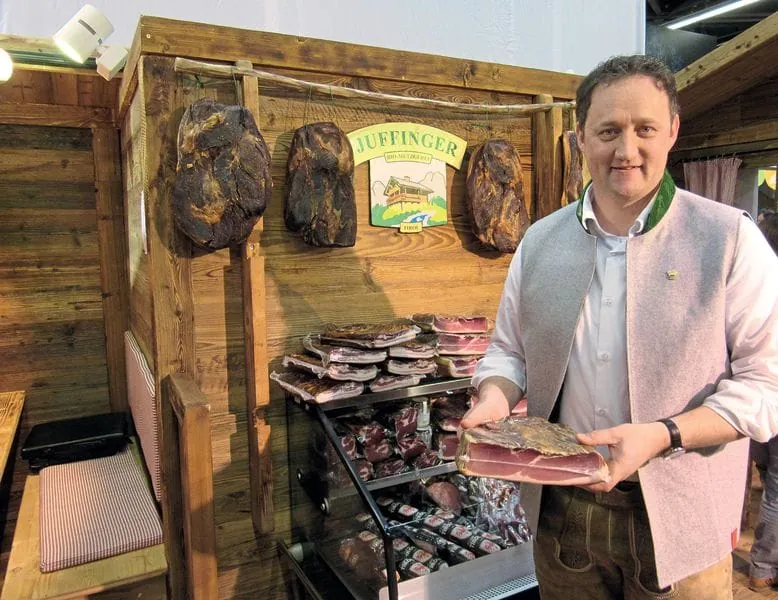
Regionality is currently one of the most important sales arguments in favor of organic meat. Anton Juffinger sees this from his experiences in Thiersee in Tyrol. His company has been growing continuously since its foundation in 1997. Juffinger lives and breathes regional origin. The keyword for the origin of his animals is “Alps”. All were born in the Alpine region and raised by local family farms whose work complies with the Alpine Convention. This international treaty from 1991 promotes and regulates the comprehensive protection and sustainable development of the Alps.
Juffinger offers products from organic Alpine beef, organic Alpine calf, organic Alpine pork, poultry, lamb and recently also from organic Alpine wagyu, which he buys from a farmer in Kitzbühel. The demand for Alpine lamb is currently particularly strong, reports Juffinger. The animals are slaughtered at between four and eight months of age. But the entrepreneur also observes other factors than simply the origin of the animals. Because the sustainability of self-service packaging is important to him, 70 percent of these are made of paper.
Cardboard instead of plastic film
What demands do organic customers make on packaging? What influence does packaging have on the perception and purchasing decisions of organic customers? Horst Bittermann, President of the professional association Pro Carton, and Dr. Melanie Bowen from Justus-Liebig University in Gießen presented studies, analyses and arguments in their congress lecture. In a representative study in seven European countries on seven markets with a total of 7,000 respondents, Pro Carton determined that packaging influences the purchasing behavior of 75 percent of consumers. Packaging is the face of the products. It must protect them, reflect their value and be environmentally compatible. The trend is towards sustainable packaging made from renewable raw materials. “Older consumers in the EU recycle more than young people. However, they pay more attention to sustainable packaging,” explained Bittermann. In the EU, 52 percent of those surveyed had changed a product in the last twelve months because they had concerns about the packaging. In Germany this figure was 50 percent. According to Bittermann, cardboard is the first choice in the search for environmentally friendly packaging, followed by glass.
Which packaging do organic customers want?
Why are organic foods still offered in plastic packaging? Because manufacturers believe that customers expect plastics. That was one of the results of Melanie Bowen’s study. 1,252 people from Germany took part, half men and half women with an average age of 44 years. Among other things, they evaluated packaging on the basis of pictures. They were clearly aware of the differences in packaging and materials. Folding cartons produced a 12 percent more positive perception than plastic. Their credibility increased by 17 percent compared to plastic; a folding box increased the likelihood of purchase by 13 percent.
Critical congress participants expressed concerns about the protection of food in folding boxes. Bittermann argued that there are already coatings that make any plastic film superfluous. Health concerns because of possible mineral oil residues are also superfluous. Cardboard can be coated so that these residues are prevented. What remained was the question of the costs for ecological folding boxes. There was no answer, because price acceptance was not taken into account in the study.
Avoid, reduce, recycle packaging
Industrial engineer Sonja Bähr from TILISCO GmbH spoke about the possibilities and limits of sustainable packaging. She reported that ten rivers in Asia were the main sources of marine waste and gave examples of the lifespan of various types of waste. Fishing line takes 600 years to decay, plastic bottles 450 years, and wool socks one to five years. In May 2018, the Verpackungsinstitut e.V. surveyed 1049 German citizens on their use of packaging. Accordingly, 92.9 percent are interested in packaging. 57.3 percent do not feel sufficiently informed. 67.8 percent believe that trade, production and packaging manufacturers have a duty to inform them.
This is where the new Packaging Act comes in with its stipulation that every distributor must register. All are responsible for taking back and recycling packaging. At the center of the materials is plastic. According to Sonja Bähr, production increased twentyfold between 1964 and 2014. Despite criticism, the plastics industry is again expected to grow by 3.9 percent. The German and European goal, however, is a different one: Avoid, reduce, and recycle packaging. Currently, consumers are practically at a loss. Many composites cannot be recycled. Closures are often made of different materials than the rest of the package. The lids of yogurt cups must be separated so that the package can be recycled. Cheese paper consists of two layers that must be separated from each other. Even non-peelable labels prevent recycling. Some packages made of recycled material cannot be recycled again because of a composite. Anyone who believes that packaging waste is only an issue for industrial nations was reproved by Sonja Bähr: Kenya has banned plastic bags since 2017, Indonesia and Bali since 2018 and in India, a ban will go into effect starting in 2021.
Goodbye special shops – more organic for all?
A major change in the organic trade in 2018 was the offer of Verband-Bio in discount stores. Bioland at Lidl: this sounded like the answer to Demeter at Real. So far, the health food specialists could refer to themselves as nearly the exclusive providers of organic foods in the association. The advantage was that critical organic customers bought organic products from specialized retailers because the standards of organic associations are stricter than those of the EU Organic Regulation. How the cooperation between Bioland and Lidl will develop in the long term remains to be seen. The opinions of organic farmers and producers heard in conversation at the BioFach fluctuate between hope and fear. On the one hand, they hope for positive developments in demand and sales, which will enable them to invest and grow their business. “We want as many consumers as possible to consume organic products,” said a Bioland farmer who keeps and markets Bentheimer pigs. Another argued that it was not specialized trade customers who bought organic association products in discount stores but discount customers who gain access to organic wares. Lidl would thus not take anything from the specialized shops. On the contrary. An expansion of organic agriculture in the associations would benefit the environment and thus everyone. However, farmers are also afraid of possible consequences such as price pressure and negative price developments, including a loss of value for their goods.
Culinary treats from Korea
From a nutritional point of view, what is the optimal side dish for meat? The current answer is kimchi. The Korean national dish made of fermented Chinese cabbage with spices, sometimes also called Asian sauerkraut, is said to be the reason for the good health of the Koreans. Fermentation is the trend, especially since it is known that the large intestine is an essential control point of the immune system. For it to work, it needs the diverse bacterial flora that are aided by lactic acid bacteria. These are produced during the fermentation of vegetables and dairy products. There is one rule that must be observed: Fermented food must not be sterilized because this destroys the bacteria. At BioFach, many exhibitors presented fermented products, including cheese substitutes, spreads and vegan quark substitutes. Bio verde offered three varieties of kimchi for tasting: the original with a hint of garlic, one with ginger and another with turmeric.
Grandchild-friendly agriculture
Residue-free organic cultivation is becoming increasingly difficult due to dwindling biodiversity and the loss of soil fertility from the chemicals used in agriculture, and from drinking water and air that are contaminated with agricultural pollutants. The current legal situation provides that organic farmers are liable for contamination ultimately caused by others. The mission statement of the Alliance for a Society of Grandchildren-Friendly Agriculture states: “We need fundamental change in order to maintain soil health and an intact animal and plant world as well as clean air, so that we can supply people with contaminant-free food.” One of the alliance’s partners is the Schweisfurth Foundation; others include Bio Company, Rapunzel, Sonnentor, Ökoland and Allos. In addition, there are numerous funding partners.
At BioFach, the alliance presented grandchildren-oriented agriculture, introduced study results and informed listeners about the results of a bio-monitoring project on pesticide pollution in the air completed by the TIEM Integrierte Umweltüberwachung GbR. The Dortmund Institute had measured 107 pesticides, including glyphosate.