
At his official farewell upon retiring as chairman of the Belgian Meat Office, René Maillard also had some positive news to report. Together with 25 trade journalists from all over Europe, market developments unrelated to the African swine fever were discussed.


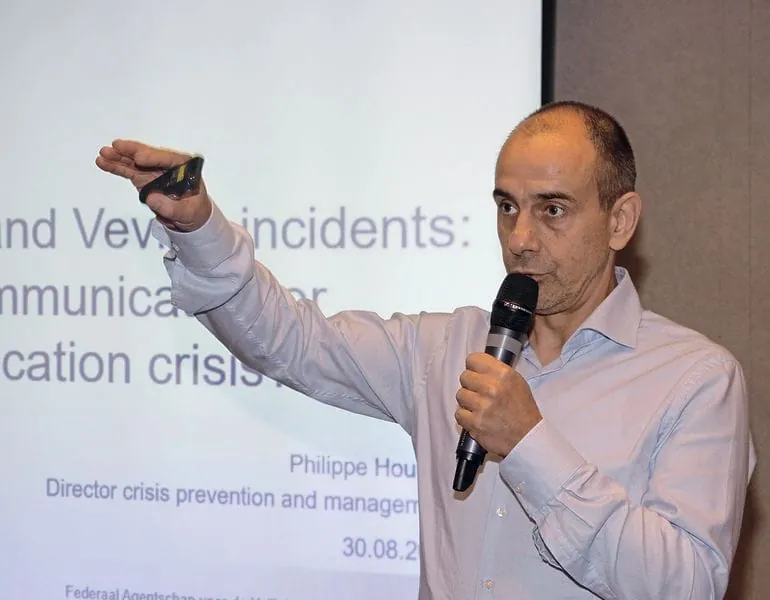
At the traditional “Round Table” in Brussels, scientists Prof. Dr. Frederic Leroy (Research Group Industrial Microbiology and Biotechnology at the Free University of Brussels) and Dr. Lic. Phillippe Houdart (crisis expert at the Belgian Agency for Food Safety) provided a detailed examination of journalism about meat and its background. Their conclusion? Even in this age of “alternative truths”, there are a few examples of neutral, not tendentious, and even positive reporting about the appropriate role meat can play in a diet.
Altogether, the development of meat consumption in most countries is rather positive, according to Maillard. In Europe, meat consumption remains at a fairly stable level. Again and again, however, said the professionals, demands for reduced meat consumption are made. In this case, the focus is more on environmental protection and consumer health. In recent years, the topic of animal health and welfare has also received much media attention. issues such as the BSE scandal of past decades, however, are now over. This means that meat is no longer completely considered to be unhealthy.
The image of animals – as experts explain – has changed in the consumer’s mind. Hardly any typical central European sees animals primarily as a source of food. They tend to be considered more like pets – cats, hamsters and dogs – which are usually not considered as food in Europe. The transfer of this image to pigs, calves, sheep and beef is obvious. Thus, the aspect of animal welfare has replaced the importance of nutritional value on the scale.
Arguments for meat
There are still advocates of meat. When examining the results of a search for “meat” on the online pages of the British daily newspaper “The Mail”, Prof. Leroy often found the terms “strength, vitality and fertility” in connection with meat consumption. In addition, the expert regularly finds tips in this publication about preventing malnutrition in children who grow up without eating meat. He even found the headline “Woman considered barren has triplets after adding meat to her diet”.
Although the tenor of this article is positive, it is still no reason to cheer, says the scientist. When possible, daily newspapers such as Germany’s “Bild” or England’s “Sun” are always eager to use real or imagined meat scandals for their own marketing purposes. The headline with the question whether meat consumption – and in this context, greenhouse gas emissions – could completely depopulate the planet, was by no means published as a bad April Fools’ Day joke. Likewise in the UK, prepackaged meat that promises contactless preparation is now available.
The professor considers it absurd that vegetarians live longer per se. Lifestyle also plays a role. The relationship between long life and meat consumption, compared to other risks such as smoking or obesity, is often concluded without any scientific proof. The connection between attainable age and meat consumption as well as other risks such as smoking or obesity are often artificially constructed and have no scientific proof. As an example, the scientists mentioned that sunlight could cause skin cancer, but it is necessary for the formation and intake of the essential vitamin D. The risk of developing skin cancer, according to researchers, is not less for vegetarians than for meat friends.
The conclusion was thus: “It’s often ideologies and even religious settings as well as sophisticated lobbying.” Those whose intention is to proclaim their respective opinions can always deliver a good story and influence people about their point of view.
In this context, it is still possible for media to get on the wrong track and initiate scandals, as Philippe Houdart made it clear. He reported in detail about the course of the “Fipronil” insecticide affair in the poultry industry. Here, an individual case caused a major stir, he said. The substance affected animal feed to eggs and involved one-third of the Belgian poultry industry. “We wanted to be as open as possible about the problem when the discussion started,” said the expert. Unfortunately, this did not work out as planned. But there was never a true risk for the consumer – despite the many negative headlines. “We greatly underestimated the communication needs,” the expert confessed.