
Converting liquid smoke into true smoke requires specialized knowledge and highly developed technologies. In addition to the concentrated smoke product, a high-performance smoke generator that precisely and reliably regulates the necessary parameters is the key to successful smoking.
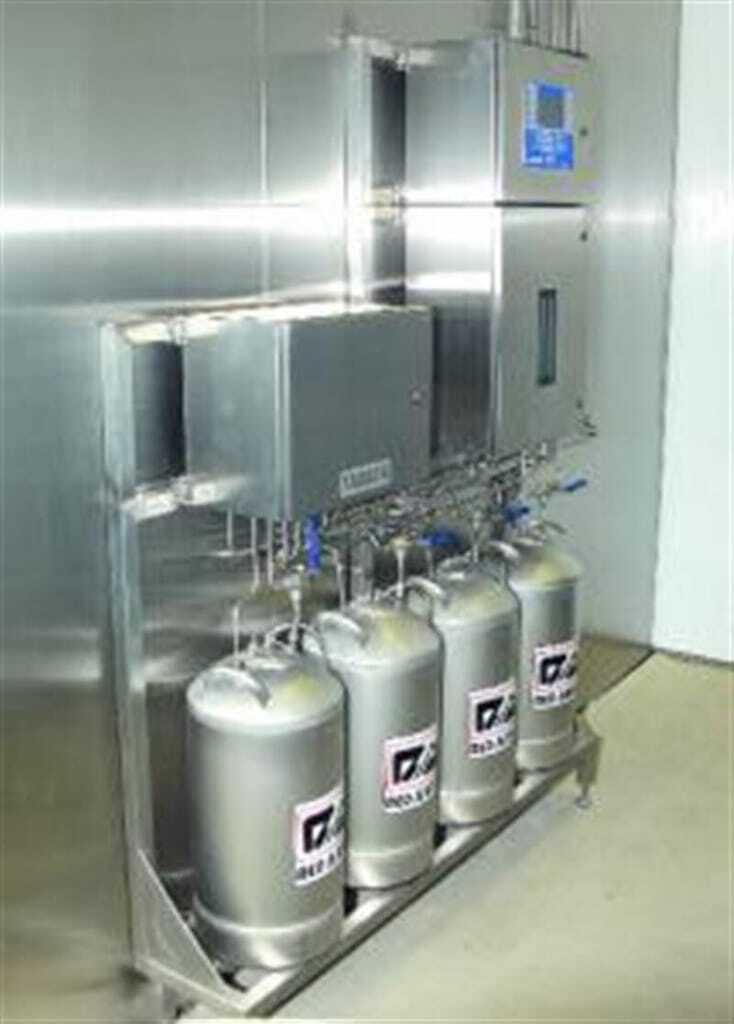
Modern smoking technology
◆Red Arrow (Bremen, Germany) has long researched the chemical and physical characteristics of the smoke used in traditional smoking procedures as well as the mechanisms that occur during transfer of this smoke to foods being smoked. The chemical composition of smoke is highly complex. But the functional components of the smoke responsible for the essential qualities of a smoked product are contained in the condensable fraction of the overall smoke. Sophisticated manufacturing processes can create highly concentrated smoke condensate containing all components of the condensable fraction of fresh smoke. Any device responsible for converting liquid smoke into that used to treat foods must regulate all parameters to develop a stable smoke cloud with a gas phase and a controlled particle phase with defined particle size distribution.
According to Red Arrow, the “Tarber Smoke Master TG 3000micro” and “TG 4000micro” systems are constructed to dose the exact amounts of both liquid smoke and pressurized air to a calibrated two-media nozzle in the smoking system. Electronic proportional pressure controllers that supply the desired air pressure and pressurized air volume ensure stable, economic conversion of liquid smoke to smoke during the entire smoking process. Studies of particle size distribution under varying conditions during conversion of smoke condensate to smoke have shown that air currents in smoking equipment circulation systems disturb the atomization process. They enable larger particles to form, which make the smoke less efficient and increase liquid smoke consumption.
“Tarber Smoke Master” systems include a microprocessor that monitors the circulation system of the equipment during smoking to ensure that it does not affect the system during the atomization process.
The “Tarber Smoke Master” is constructed to monitor circulation controllers and smoking facility types made by various manufacturers. Two other important factors are a constant volume flow of liquid smoke as well as the certainty that the optimal air pressure and air volume reach the two-media nozzle. To control and monitor these parameters, the “Tarber Smoke Master” atomizer is equipped with electronic proportional pressure regulators and software designed to guarantee perfect control of compressed air and liquid smoke consumption.
The necessary settings are determined individually during initial start-up of the “Tarber Smoke Master” and programmed into the liquid smoke system’s microprocessor. Continual comparison of the settings with actual values and safety functions ensures development of true smoke with the desired gas and particle phases. The volume flow of the liquid smoke and the fixed atomization interval thus control the smoke density generated in the system. Furthermore, control of the smoking system’s ingoing and outgoing air flaps during smoking prevents emission of smoke with outgoing air and minimizes liquid smoke consumption. In contrast to fresh smoke, smoke developed from liquid smoke contains no explosive mixtures because the ash and tar fractions are removed during manufacture. This makes smoking safer and lowers production costs because less time is needed for monitoring the smoke generator. Products can also be smoked at night without supervision.
During operation of smoking equipment with liquid smoke, the “Tarber Smoke Master” replaces the conventional smoke generator. This eliminates costs for complete cleaning of the smoke generator, thus reducing maintenance costs for smoke generation. The combination of high-quality liquid smoke and mature atomization equipment enables controlled, uniform smoke composition.