
Suttero Bazenheid is one of Switzerland’s most modern meat processing centers. The production site belonging to Ernst Sutter AG cuts beef, calf and pig carcasses or further processes it for wholesale and retail dealers.
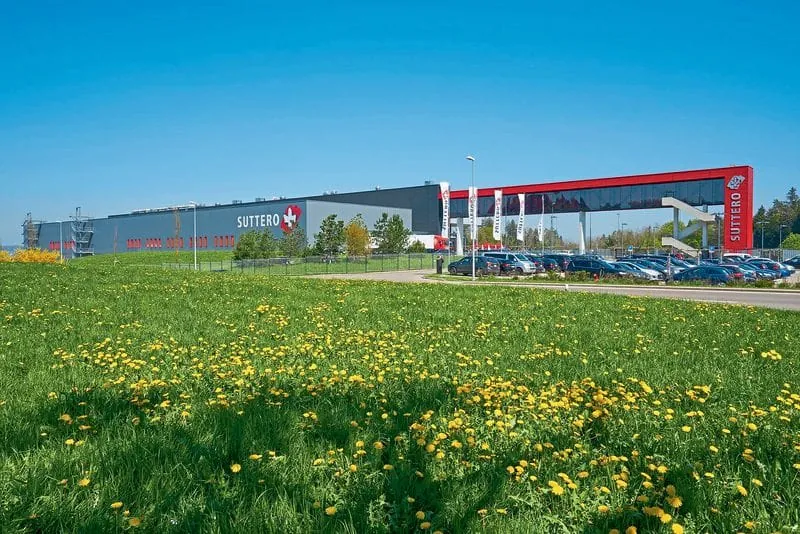
Opened in 2012, the Suttero Bazenheid meat processing center was constructed according to the “Minenergie” standard and thus meets the strict guidelines for sustainable construction. A photovoltaic system has been installed on the roof for environmentally friendly energy, which also feeds power into the regional public network. The Ernst Sutter AG – and thus its Suttero Bazenheid production sites – draw their electricity solely from hydropower. In addition, approximately 75 percent of the energy from the generation of cooling is also used to produce hot water. Suttero Bazenheid uses a central vacuum system made by Busch to generate the vacuum for its packaging process. It is much more energy-efficient than decentralized vacuum supplies for individual packaging machines. Thus, the production site meets the latest standards, both technically as well as ecologically. With six plants and two regional logistic platforms, Ernst Sutter AG is among the most important Swiss companies for meat processing and the production of meat products. It supplies butcher shops as well as wholesalers and retailers throughout Switzerland. In addition, it exports various specialties like Bündnerfleisch, Bündner raw ham or “Mostbröckli” Appenzeller in the EU countries and to the Far East.
Optimized processes
The Ernst Sutter AG has a long tradition that goes back to 1909. Today, the company employs approximately 1,000 employees. With the start-up of the Suttero Bazenheid meat processing center, most of the group’s fresh meat processing operations were concentrated at this location. The raw material, usually pork and beef carcass halves, is obtained for the most part from the nearby Bazenheid or Gossau slaughterhouses. The half-carcasses are sent to separate cold-storage rooms. A fully automated control system retrieves the individual halves from the cold-storage rooms and sends them to the respective cutting lines.
All jobs on the cutting lines are equipped with the most modern computers that show the respective employee the work steps to complete. These steps are electronically recorded and assigned to the individual cuts. This enables each portioned cut of pork or beef to be attributed to the corresponding half-carcass for easy tracking or retrieval of its origin or other information.
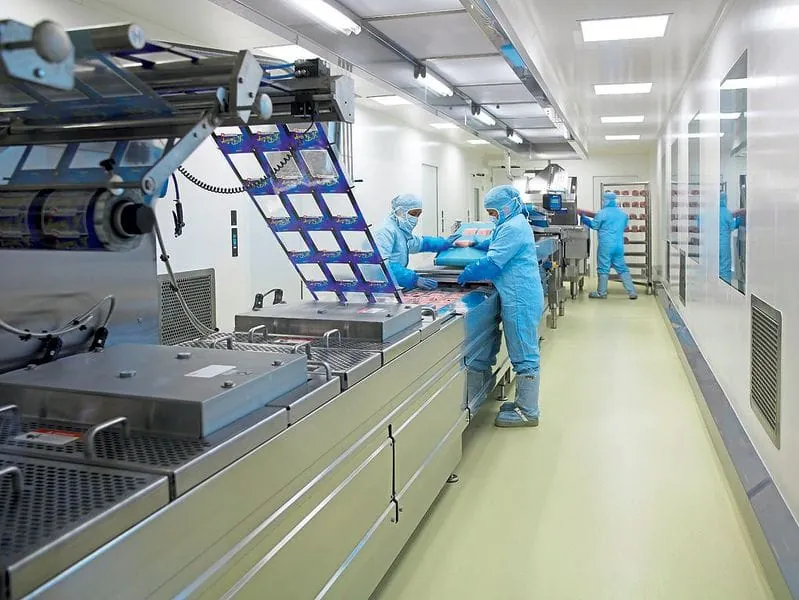
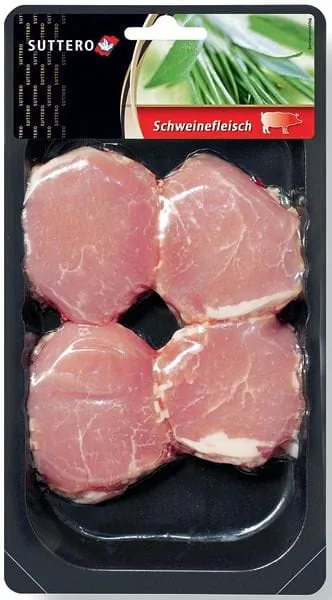
Fresh meat products are packaged on eight packaging lines furnished with thermoforming or tray-sealer packaging machines. About two-thirds of all products are skin-packaged; others such as ground meat are packaged using a modified atmosphere.
The products are packaged under various brands, including the company’s own brand as well as those of other companies. Of the total 300 employees in Bazenheid, approximately 180 work in the one-shift production operation. Extra shifts are only added if there is greater demand for fresh meat during the summer.
Centrally suppliedwith vacuum
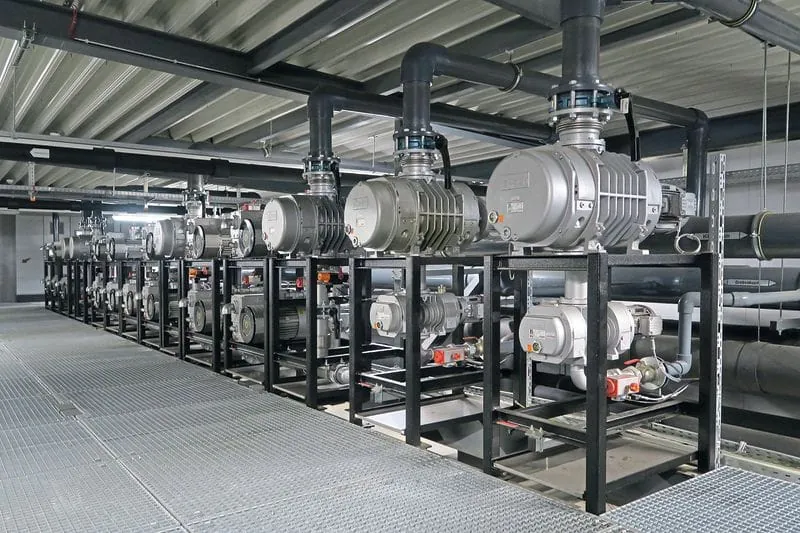
For Stefano Martinotti, Head Areas and Technology, it was clear during the planning phase that the vacuum necessary for packaging should be generated by a centralized vacuum system because this is the most energy-efficient type of vacuum production. Fundamentally, a central vacuum supply requires fewer pumps than decentralized vacuum production. In addition, the two-stage evacuation process allowed the installation of rotary vane vacuum pumps with smaller suction volumes and thus, lower engine power. The Busch central vacuum system supplies the tray- sealer packaging machines with three independent ring lines. One always maintains a low vacuum of 50 millibars. A vacuum reservoir guarantees permanent and fast availability of the required vacuum level. A second ring line creates a medium vacuum of four millibars. The packages are first evacuated using the low vacuum level. After this, a valve switches to “medium vacuum” and the final evacuation down to four millibars final pressure is completed. This control rapidly and reliably evacuates the packaging chamber and packages before closure and achieves the fastest speed.
A third independent ring leads to the packaging lines with thermoforming packaging machines. It serves the thermoformers in the packaging lines with the so-called form vacuum of 100 millibars, which draws the heated plastic film into the forms.
Energy-saving solution
The needs-based control of the central vacuum system ensures that the required pressures are automatically ready for deployment in all three ring lines. Only the needed vacuum pumps are ever in operation. Because not all packaging lines always package at the highest cycle times and maximum packaging volumes, only some of the vacuum pumps are generally used.
The central vacuum system saves additional energy because vacuum pumps are no longer needed in the packaging rooms. The heat dissipation from operation of the vacuum pumps and the warmed exhaust air are not directly reintroduced into the packaging rooms. Less power is thus necessary for air conditioning the rooms, which also has positive effects on energy consumption. Because the central vacuum system is installed in an intermediate floor directly above the production and packaging rooms, its exhaust air is used for heating the floor in winter.
Maintenance during ongoing operation
In addition to energy efficiency, the operational safety of the vacuum supply obviously has the highest priority. “Only a central vacuum system,” says Stefano Martinotti, “guarantees redundant and reliable vacuum supply for all eight packaging lines.”
With Busch AG, the company found a partner and vacuum specialists who individually planned and implemented the central vacuum system for the technical circumstances at Suttero Bazenheid. The system consists primarily of several vacuum modules for low, medium and form vacuuming. There is also a reserve unit. This reserve unit enables maintenance to be carried out during ongoing operation. In this process, individual modules are swapped out for maintenance. The reserve module is automatically switched on. This has the advantage that no maintenance technicians must enter the hygienically sensitive packaging and manufacturing area. The essential components of the central vacuum system are R 5 rotary vane vacuum pumps and Panda vacuum boosters. This combination significantly increases the system’s suction capacity and the final pressure, although its energy consumption is less than systems featuring larger vacuum pumps with comparable performance.
The needs-based control is programmed so that all vacuum pumps reach the same number of operating hours, even though not all vacuum pumps are in simultaneous use. The advantage of this is that in contrast to the installation of decentralized vacuum pumps directly at the packaging machines, where they constantly run, each vacuum pump works for fewer hours overall. This allows the service intervals to be extended. In regard to service intervals, monthly visual inspections of oil levels are always carried out. During annual maintenance, oil changes and filter replacements are made.