
The highest product quality, flexible and efficient workflows that ensure cost-effective consumption and hygiene-compliant processing – these are the most important arguments for the Cryoline CW multipurpose freezer, which gently freezes sensitive convenience products. Tip Top Poultry, a leading poultry marketer in the US, now relies completely on Linde’s innovative tunnel freezer: The company was able to reduce its costs, gain additional capacity and avoid production bottlenecks.
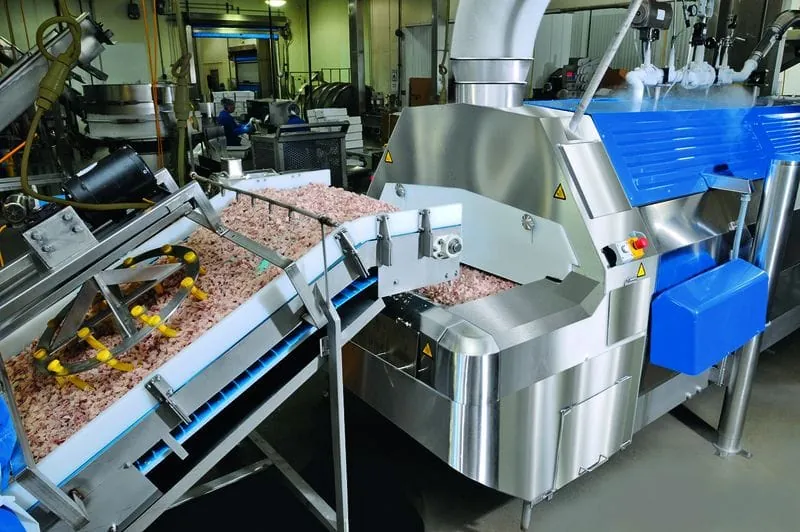
Tip Top Poultry (Marietta, Georgia/USA) is the largest marketer of rotisserie and boiling chicken in the US. As an important supplier, the company provides American caterers and the country’s food industry with deep-frozen poultry meat on a large scale. The prerequisite for the highest level of product quality is the latest generation of cryogenic freezing technology.
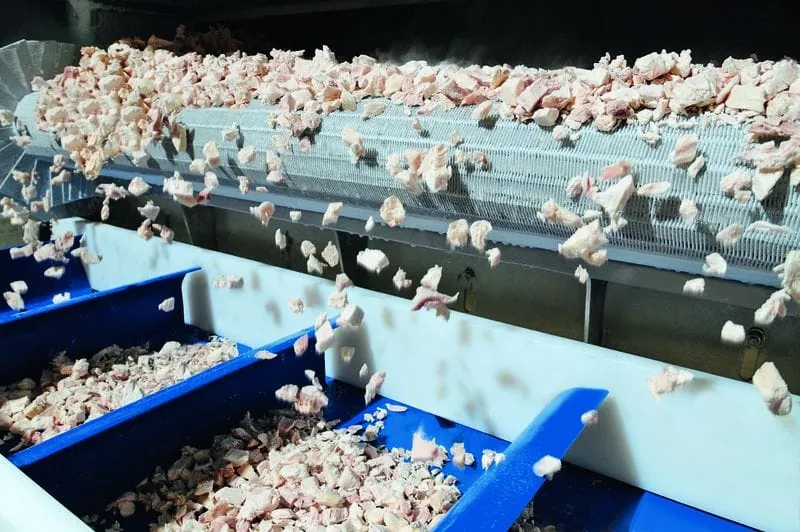
Tip Top Poultry’s specialties are so-called IQF products (“Individually Quick Frosted”), which are produced at the company’s site in Rockmart, Georgia. The frozen poultry parts are then used as ingredients in soups, salads, meat pies and other convenience foods. Cooked chickens are deboned, their meat filleted, cubed to a size of 0.6 to 2.5 cm and then loose frozen. The poultry cubes and smaller parts are then separately packaged for sale. Until now, three freezers operating on carbon dioxide (CO2) were used in Rockmart for freezing and packaging cubed chicken meat and other IQF products. These freezers supplied two packaging lines.
Water under the bridge
For more than twenty years, CO2-operated freezers were the most important processing technology for producing individually cubed poultry meat. But they revealed a number of shortcomings: When carbon dioxide is used for freezing, residues can build that deposit dry ice snow on the products and in the interior of the machine. Fixtures must be freed of snow several times per shift; smaller poultry cuts must be de-snowed immediately after freezing. Both lead to efficiency losses, increase maintenance and more effort – thus causing higher costs. “With carbon dioxide,” finds Tip Top plant manager Curt McNiff, “we had to deploy additional manpower and equipment in order to remove the snow from the smaller poultry parts so that they could be packaged. If they were packaged with the snow, you would end up with shortfalls in weight.”
The innovation: Cryogenic nitrogen
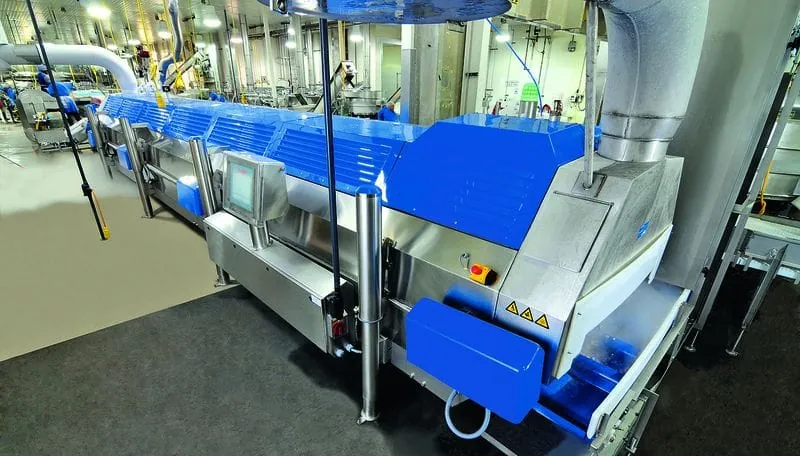
This is why Tip Top now uses a more efficient but likewise high-quality procedure for processing poultry meat: freezing with cryogenic nitrogen (N2). In contrast to carbon dioxide, which sublimes at –78.5 °C, the freezing point of nitrogen is –196 °C. Its cooling capacity is correspondingly higher, which requires less refrigerant. Especially for cooked poultry meat with its high moisture content, this is a distinct advantage because no dry ice snow forms. At the beginning of 2012, after in-depth investigation and technical design by Linde, Tip Top replaced two of its three carbon dioxide-operated freezers in Rockmart with one eight-meter long Cryoline CW tunnel freezer from Linde’s modular Cryoline product line. It can use either carbon dioxide (CO2) or nitrogen (N2) as a cooling medium.
Efficient and gentle
The Cryoline CW scores above all due to its combination of two procedures in one device: In the front of the machine, the wave-like motion of the belt – the so-called Cryowave system – separates the food to be chilled so that no agglomerations develop during the freezing process. The refrigerant is conducted from front to back working on the direct current principle. The individual products begin quickly hardening in the front area. The final freezing process takes place in the rear of the blast freezer. The fast hardening immediately seals the moisture. This maintains the weight of the product, which in turn leads to increased yield and quality.
“The Cryoline CW is gentler on the product, consumes less refrigerant and eliminates the extra work associated with the removal of the carbon dioxide snow,” says plant manager McNiff. A further advantage is that the conveyor belt can be easily and densely loaded; the cubed poultry can be layered up to five centimeters high on the belt in a continual process – and this with a utilization rate of nearly 100 percent.
Another decisive argument for the Cryoline CW is the shortened freezing time that nitrogen requires. Where five minutes were previously required, the freezing time has now been reduced to between one-and-a-half and maximal three minutes. Freezing cubed poultry ranges on the lower side.
Optimal construction and operation
Plant manager McNiff is also convinced of the tunnel freezer’s flexibility, ease of operation and hygienic design. The wave technology and basic settings of the controlled system can be flexibly programmed to make fast changes that meet customer-specific requirements rapidly and economically. Clearly organized touchscreen control panels support the production and documentation process. Self-diagnosis tools recognize malfunctions during operations so that the necessary corrections can be immediately carried out. Extensive protocol functions also guarantee product traceability. In addition, the Cryowave – like all freezer models in the Cryoline product line – combines completely hygienic construction with sloped surfaces, food-grade materials, interior seals and only a few movable parts in the interior, which are all easily accessible for maintenance. Cleaning is only necessary once per shift – a plus point that is further exploited by the concentration on one system. “If we look at the automation technology in the packaging area and let the entire IQF production run through a single freezer, we would only have to purchase a scale and a bagging machine,” says McNiff. “Functions that allow everything to be processed by a single system reduce operational work and cleaning needs.”
Continuous service
It was not only the technological advantages of the Cryoline CW that were the decisive factor that convinced Tip Top Poultry to modernize its assembly line. Linde also won the company over with its service. Linde’s technical experts assisted Tip Top during the entire conversion process, from the initial review process and first calculations to installation all the way to monitoring the ongoing operations. “Linde achieved all planned objectives, and the savings were significant,” sums up McNiff. “They supported us a great deal before, during and after installation and start-up. Even now, they are regularly on site and make sure that everything is running as well as possible.” But there’s even more: Linde ensured a further improvement of the production processes. By expanding the Cryoline CW by one modular extension three meters in length, Tip Top now no longer needs its third carbon dioxide-operated freezer and can cover all of its production needs with a single tunnel freezer.