
Strict hygiene must always be maintained – from the production of the raw materials for food to delivery to the final consumer. At all stages of the value chain, food businesses are legally obligated to ensure that work is carried out in a hygienically impeccable manner.
The food industry itself is primarily responsible for quality assurance (QA) in the entire production and processing chain. A food company’s “hygiene self-monitoring” system is therefore particularly important because it is responsible for all hygiene-relevant activities. Regulatory authorities essentially exercise a monitoring function.
With the development of European hygiene legislation, the responsibility for food safety has been transferred to businesses. The introduction and implementation of “good manufacturing practice” (GMP), “good hygiene practice” (GHP), the “HACCP concept” (HACCP = Hazard Analysis Critical Control Point/Risk Analysis Critical Control Points) and various quality management systems (QMs) in food production and manufacturing have increased the significance of two terms: food safety and consumer protection.
The EU Regulation (EC) No. 852/2004 on food hygiene requires everyone who handles or markets food to set up a HACCP concept. The EU hygiene regulation applies to all commercial industries that come into contact with foodstuffs in the aforementioned sense. The HACCP concept is internationally recognized as a food-specific system for the prevention of health risks to consumers and is an important component of all food safety management systems. At all stages of production, processing and distribution, including primary production, operators are required to carry out their own checks in accordance with HACCP principles.
Quality assurance and quality management
There is no getting around QS when it comes to eliminating defective goods via error detection and avoiding faults in the first place by taking appropriate measures in advance. While QS deals with documented facts, QM focuses on continuous quality optimization. To avoid liability risks, it is advisable to know the most important EU regulations as well as national legislation, and to seek advice from food experts. Despite the shift of responsibility for food safety to businesses, the new food hygiene legislation substantially expands the general obligations of authorities to monitor controls. As a result, official bodies have a new role to play in checking GHPs and the “HACCP-based procedures” set up and followed by businesses. In some German states, interdisciplinary departments of specialists cooperate with municipal food control authorities to develop and implement control programs and audits of self-monitoring systems in food companies.
Certifications and audits
According to the new EU hygiene regulations, establishments that handle animal-based foods require both EU approval and an HACCP concept. The magnitude of the business’s concept correlates to its size. Accredited, independent experts provide advice, training and optimization, and even crisis management – as well as hygiene audits or commercial and supplier audits.
Personal hygiene
Employees in food processing companies must meet and maintain a high level of hygiene, including:
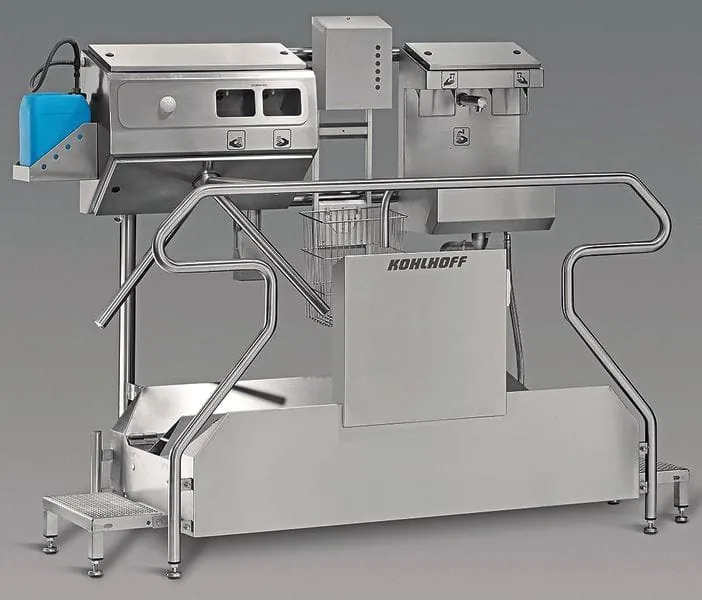
- Thorough handwashing and disinfection before starting work and after use of the toilet;
- Exclusive use of clean work apparel;
- No use of nail polish, or wearing of jewelry or wristwatches;
- Observance of personal hygiene;
- Complete coverage of any wounds;
- Regular training on food hygiene.
The basic legal requirements for personal hygiene are stipulated in § 42 of the Infection Protection Act (IfSG) and taught in food hygiene training courses in accordance with § 4 of the Food Hygiene Ordinance (LMHV). Persons who produce, handle and market meat products must have a certificate according to § 43 IfSG.
Industrial hygiene
Industrial hygiene includes, among other things, measures to keep work rooms and work equipment clean:
- Spatial separation of clean and unclean areas;
- Storage of waste in separate rooms;
- Separate workstations, for example, for preparation of vegetables or meat;
- Consistent cleaning of all equipment that comes into contact with food;
- Cleaning of food storage or preparation rooms;
- Use of different colored cleaning cloths for different applications.
Further hygiene requirements for operating rooms include, for example:
- Easily washable worktables without cracks;
- Refrigeration units set to the optimum temperature and regularly defrosted;
- No wooden cutting boards used for meat;
- Packaging material that is non-hazardous to human health;
- Easy-to-clean floors;
- Sufficiently illuminated and ventilated working areas;
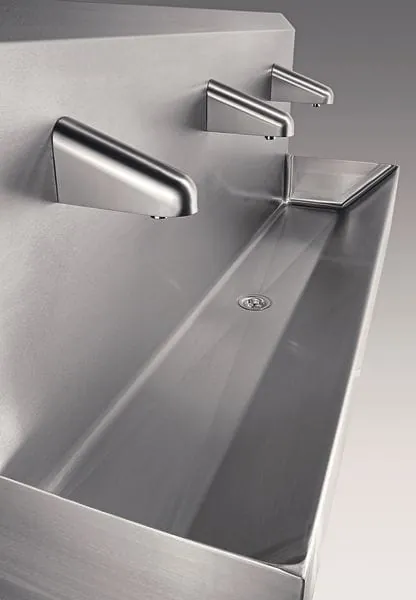
- Washbasins dedicated for handwashing (with soap, disinfectant and disposable towels).
Product hygiene
The aim of food hygiene is to allow as few undesirable microorganisms as possible to come into contact with food during the production and product stages, and to kill any microorganisms that may be present or prevent them from multiplying. The following aspects, among others, are decisive for optimal product hygiene:
- Maintaining the specified temperatures throughout the entire processing operation;
- Uninterrupted cold chains for products requiring refrigeration;
- Observation of measures for proper personnel and operational hygiene;
- Strict separation of the tools used for different products;
- Observation of the “first in – first out” freshness principle in sales;
- Separate storage and presentation of meat, sausage, cheese, fish and salads.
Traceability and identification marks
Companies that handle food of animal origin and are subject to approval must attach identification marks to their packaging before sending the products to market. The ID marks contain the abbreviation for the country of origin (DE for Germany), the registration number of the business and the abbreviation for “European Community” (EC). An identical mark – the health mark – is applied to carcasses after official inspection.
Transport and storage
Basically, three groups of risks can be distinguished, which can apply equally to this area:
- Physical: Penetration of foreign bodies into goods during storage, handling or transport;
- Chemical: Residues of chemical substances such as escaping coolant, cleaning residues or oils;
- Microbiological: Contamination by micro-organisms, residues from previous batches or non-compliance with the cold chain.
According to the VDKL guidelines of the Association of German Cold Storage and Refrigerated Logistics Companies (Verband Deutscher Kühlhäuser und Kühllogistikunternehmen e.V.), critical points exist only for refrigerated goods, especially when they are delivered to the cold storage area or processed. All others are control points for hygiene and quality. Devices and containers for storing and transporting foodstuffs must be kept clean, including between loading operations.
Temperature controls
Compliance with the cold chain must be verified and documented using temperature controls at goods receipt, in the warehouse and during transport and production. Here, instead of random self-checks, continuous monitoring is desirable, but not obligatory. Temperatures in cooling areas should be monitored at least once a day. Data loggers that transfer the information directly to the PC, for example, provide the necessary transparency.
Waste disposal and pest management
Hygienic waste disposal requires, among other things, waste separation and labeling of lidded containers. Storage away from hygienically clean working areas is just as important as the rapid removal of waste from rooms where food is handled. Preventive and acute management for pest control must also be demonstrated throughout the entire business. In this regard, the effectiveness of the individual measures for hygienic waste disposal and the corresponding documentation are assessed.
Drinking water analyses
Food production uses water from the public network; this water must meet the requirements of the Drinking Water Ordinance. If necessary, tests of the drinking water must be carried out by a recognized institute. Wastewater systems must be designed so that they cannot adversely affect foodstuffs.↓
Cleaning and disinfection
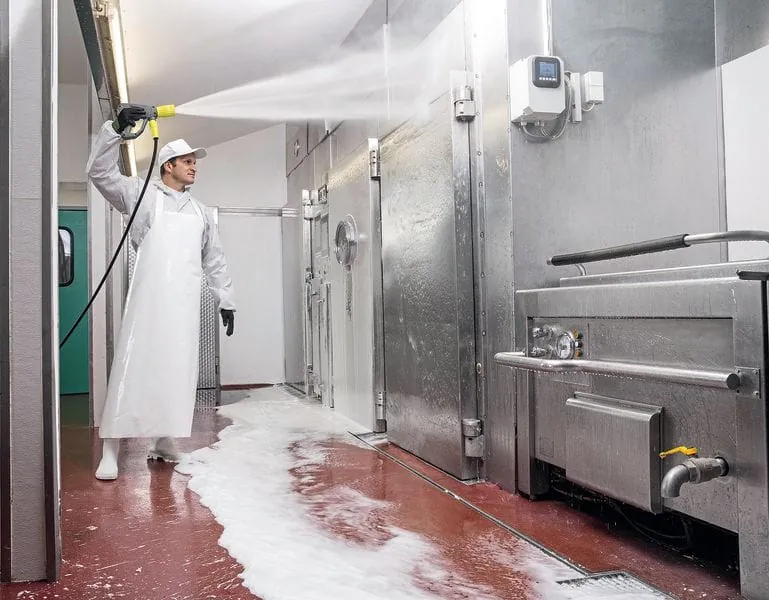
For effective disinfection in food processing plants, cleaning is essential in order to remove germs mechanically as well as to remove any possible breeding grounds. A reduction of germs by up to 90 percent is sufficient for many surfaces. Disinfection is only necessary for surfaces that come into contact with easily perishable food.
Scrubbing or rubbing surfaces allows the cleaning agent to interact intensively with soiling. At the same time, the chemical composition of the cleaner must be adapted to the requirements. Alkaline agents are particularly suitable for removing fat, protein and smoke deposits. Acidic cleaners are particularly suitable for the removal of limestone. Neutral cleaners with lower effectiveness than alkaline or acidic cleaners are particularly skin- and material-friendly.
Detection and control
To avoid contamination and cross-contamination by surfaces that come into contact with food, cleaning and – if necessary – disinfection must be carried out. The DIN standard 10516 “Food hygiene – Cleaning and Disinfection” is the basis for these measures. As proof of disinfection, the relevant EN standards apply throughout Europe. Germany also requires the disinfection certificate according to the German Society for Hygiene and Microbiology (DGHM) as a prerequisite for a listing with the Association for Applied Hygiene (VAH).
It is helpful to obtain not only a safety data sheet for each cleaning and disinfection agent used, but also a technical data sheet, as part of the self-control documentation. In order to fulfill the legal concepts, the hygiene measures taken must always be verified. That means that they must be measurable. DIN 10516:2009-05 specifies the various test procedures for controlling the effectiveness of cleaning and disinfection.