
The primarily purpose of legally compliant food labeling is food safety and thus, consumer protection. But what mandatory information must appear on the packaging or the label? How do labels have to be designed to meet the legal requirements? This article identifies this obligatory material and presents various labeling and printing solutions.

Throughout the EU, the Food Information Ordinance (LMIV) uniformly regulates what information must appear on food packaging. The mandatory information defined in Art. 9 LMIV must be clearly visible and legible.
First, the name of the food and all its ingredients must be listed in descending order by weight. The net quantity of the food by number of units, weight or volume must also be noted. Finally, the expiration date or consume-by date, or in the case of frozen meat or fishery products, the date when they were frozen, must also be indicated. Labels must include the manufacturer, packager, or EU-registered vendor’s contact details. Last but not least, food packaging must contain nutrition tables in a stipulated form. Accordingly, the 14 most important substances or products in the list of ingredients that are likely to cause allergies or intolerances must be specified.
Labels as information carriers
The label is still the central marking element today – especially when it comes to variable data such as price, weight or expiry date. The most suitable or necessary type of label for a particular requirement depends on the product, its use, and whatever mandatory information is required.
In principle, a food item together with its packaging and label must be regarded as a single unit. All materials, i.e. packaging, adhesive labels and adhesives, must be food-certified and chemically inert to a suitable degree. This is the only way to prevent transferring substances to packaged foods that could endanger food or human health if used in sufficient quantities.
Special label types
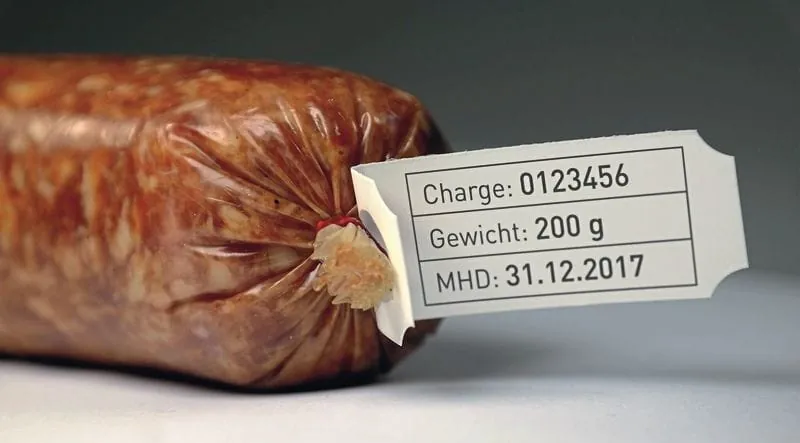
In addition to the adhesive LMIV-compliant labels, other types of sticky labels with a wide variety of designs can be used for price labeling, discount campaigns or as quality seals. Fewer legal requirements are associated with these. Common examples are round, colored action points, fair trade, premium or organic seals. Another special labeling solution is the sausage tip labels used to label sausages in conjunction with automatic filling and clipping machines. They are made of plastic (HDPE) and characterized by a very high density as well as good tear and tensile strength.
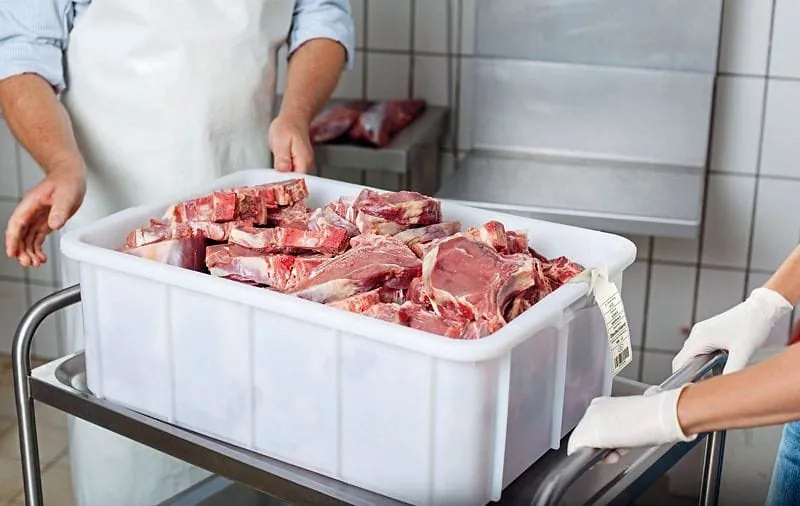
For the direct labeling of meats and sausages as well as for labeling transport or Euroboxes, legally compliant HDPE-film loop and hangtags are available. With a material thickness of usually 150 µ, they are robust and resistant to oils, fats, blood and numerous chemicals. Loop labels on rolls are available in standard formats and different colors, but label manufacturers such as Mediaform can also implement customer-specific special requests.
Suitable printing systems
Many printing systems are available for printing the required information on a wide variety of labels. The spectrum of economical solutions ranges from high-performance thermal and laser printers to ink jet printers and color printers for in-house color printing.
In this article, Die Fleischerei presents technical solutions and materials for marking and printing.