
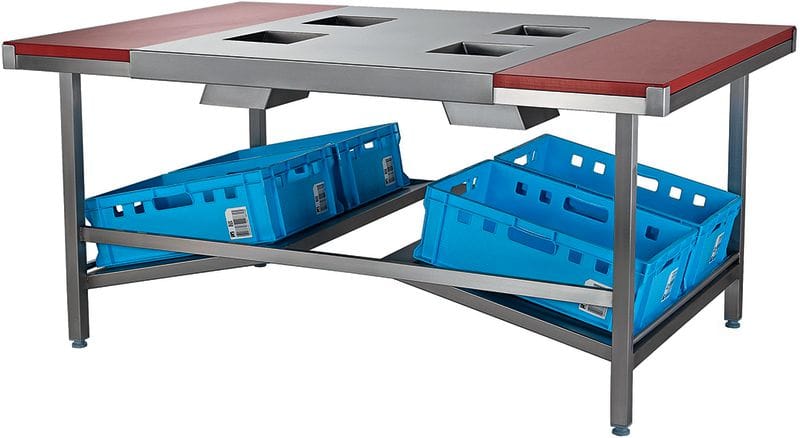
Anyone who cuts meat knows that cleanliness and hygiene are essential requirements – and how hard it can be to meet these requirements. In particular, section 11 § 2 of the German Food Hygiene Regulations (LMHV) indicates that in non-industrial slaughter houses with limited space, meat may only be cut if precautions have been taken to prevent contamination of the meat.
For hygienically flawless meat processing, cutting tables are necessary that meet the requirements of the LMHV and the HACCP guidelines. Double-stepped, cutting or sorting tables for detailed cutting and sorting of processing material must have tightly sealed and leak-proof full-metal frames so that microorganisms and bacteria do not stand a chance.
Depending on the local conditions and the intended purpose, Mohn (Meinerzhagen, Germany) offers various designs for stepped working tables or cutting tables that satisfy legal requirements thanks to their robustness and stability as well as the high quality finish.
Table bases are available with intermediate shelves, a storage grate or with struts while many cutting operations happily use the integrated delivery chutes with incorporated guide panels that enable easy sorting of cut meat pieces into Euro containers arranged inclined under the table.
In regards to optimal workplace design, it is also possible, for example, to design and construct ergonomic work tables that can be raised or lowered manually using a crank handle or at the push of a button by an electric motor to adjust the table to the right working height. An ergonomically designed workplace that enables work tables to be adjusted to the physical height and personal working method of the employee offers a range of benefits. On one hand, it is an effective means of slowing the rise in back and skeletal disorders that often occur as late consequences of permanently poor physical posture and uncoordinated movement sequences. On the other hand, the direct consequences can also be of great importance for workplace safety.
The right working conditions can lower physical fatigue as well as stresses. More sustained concentration leads to a sustainable reduction in the acute risk of accidents and injuries as well as to an increase in motivation and work quality.