
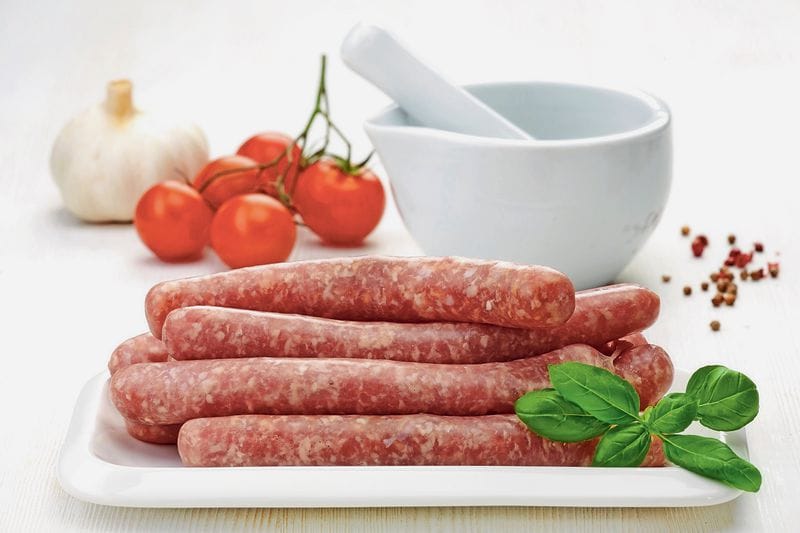
According to Innova Market Insights, snacks will be one of the top trends in the food sector in the next few years. For example, 63 percent of millennials rely on small meals eaten on the run for time reasons. Sausages are among the classics for snacking – whether a hot dog, currywurst or salami sticks, whether meat or vegetable based. Hydrosol (Ahrensburg, Germany) has developed the right casing for all of these types of sausages: SmartCasings based on alginate. Using coextrusion, sausages of all commonly used calibres can be produced. The SmartCasings are a little revolution according to the manufacturer. The alginate film is applied as a liquid to the sausage mass and then converted to a solid structure in a calcium bath. This produces a stable and edible sausage casing that gives the sausages a firm bite.
This casing also has advantages from the perspective of technical processing. “The stabilisation system is based on a complex mixture of highly reactive hydrocolloids and starches. Synergistic effects resulting from the combination with the calcium chloride solution lead to the sausage casing having good elasticity and tensile strength,” explains Florian Bark, Product Manager at Hydrosol.
The SmartCasings are suitable for fresh grilling sausages, raw sausages and boiling sausages. The casings are impressive thanks to their high tear resistance and create a pleasantly delicate bite, particularly for raw sausages.
Adapting the technology means that they are also suitable for boiling sausages, as Bark reports: “Boiling sausages are a particular challenge because they are exposed to moist heat both during their production and subsequent preparation. The casing must therefore not only be tear resistance but also adhere well to the filling even after boiling. To ensure this, the sausages are not cooked in steam while hanging but are instead cooked using a special technique in a water bath.”
The casing and the filling should be coordinated with each other for a perfect result. This applies for all product categories but particularly for boiling sausages. “Our many years of experience in the stabilisation of sausages comes to the fore here. Along with the casing we can offer the matching stabilisation for the filling. Phosphate and salt content as well as the viscosity of the filling are all taken into account,” said Bark.
Compared to existing sausage casings, SmartCasings have the following advantages according to the manufacturer: They enable a continuous production process. With SmartCasings there is no reject or reworking due to a change of intestines. The alginate casings also guarantee a higher throughput per hour than is possible with conventional filling technology. The automated production requires fewer hand movements and thus lower personnel costs. Compared to cellulose casings, the peeling step is also omitted. Last, but not least, there are savings in raw materials because alginate casings are more cost effective than natural casings and collagen or cellulose variants according to information from the manufacturer.
SmartCasings are offered as a powder. Because this has a considerably longer shelf life than ready-to-use paste, preservatives are also redundant. The paste can be prepared at any time as required. Hydrosol currently offers two powder mixes: SmartCasing M as a standard type with animal protein and SmartCasing VR as a variant for vegetarian and vegan sausages. SmartCasings are also halal and kosher.