
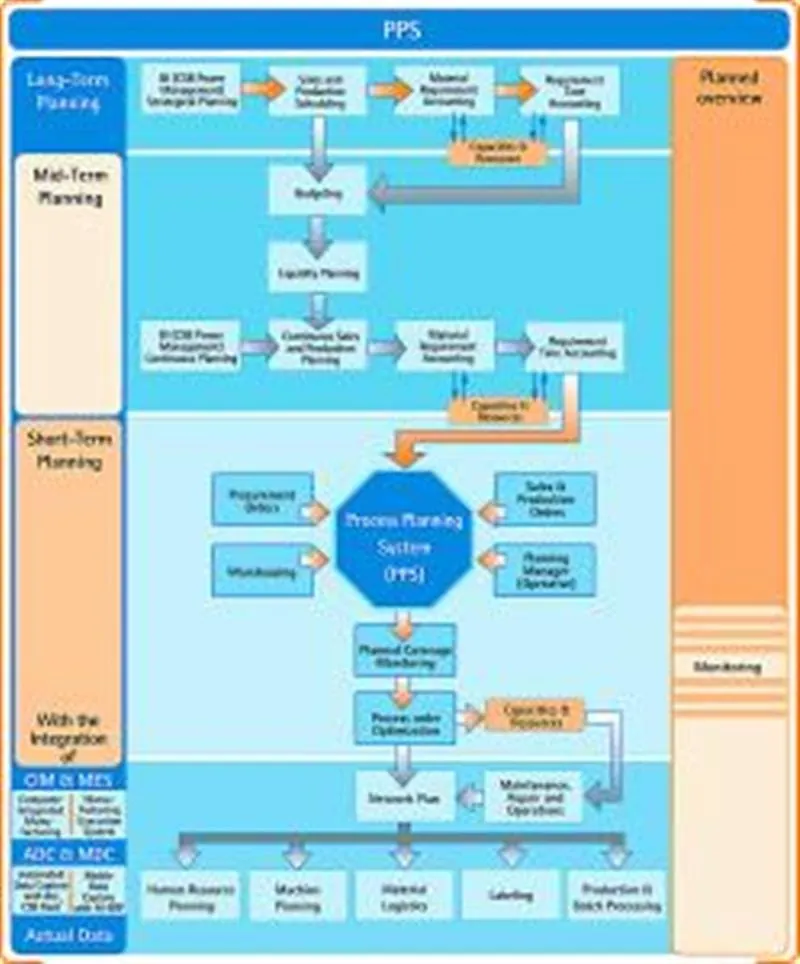
The entirely integration production Process Planning System in the CSB-System is especially tailored to the requirements of the meat and sausage industry. All production-relevant data is made available on a short-term basis to schedule operative processes. The modular composition of planning matrix and optimization graphics enables flexibility of small and large scheduling tasks throughout the entire system.
Short-term production planning
Production planning within a standardized industry solution is faced with the challenge of combining the entire spectrum of an industry and the individual requirements of each customer. A standard process planning system integrated within a standard ERP system calls for a flexible planning instrument that fully encompasses the various production processes. The implementation is performed with a freely configurable planning environment that provides all necessary factors and process procedures. This is the only way that island solutions can be avoided altogether and all production factors can be optimally utilized.
The day to day planning of production departments calls for a planning system that also considers machine capacities and material availability besides primary demand assessment. To enable ordering processes during the same morning of loading, not only do real figures have to be calculated as a primary requirement, but also plan figures from mid-term sales planning. Primary requirements, i.e. the production plan quantity, are suggested via the planned inventory stock, replenishment level, sales plan quantity and sales order quantity. Multi-level production planning considers the various manufacturing and setup times (increased response times in production).
Implementing requirements
In the process planning system, various planning procedures can be managed within freely configurable schedules. A matrix is constructed, including all columns required for calculation or development. Data can be prepared in line with self-defined formulas in freely defined formula columns. Besides freely definable data columns, the construction of a planning configuration has sort criteria to organize the view and optimize production sequences (e.g. setup-time minimization) as well as selection criteria for planning volume specification.
These requirements result in a detailed master data model that accesses BOMs (material input), manufacturing procedures (machines and production times), work time models (capacities) and setup class models (setup times during item change). Once planning has been initiated, the user will see four on-screen overviews; a navigation overview, a planning screen, a totals screen and a requirements screen.
The compact overview of all information enables the planner to see the quantities for production, the utilization of his departments and machines as well as the availability of necessary raw materials. The portrayals are automatically adjusted via navigation at sort level.
When specifying the sorting by production date, cost center, machine and production item, the totals and requirements overviews show the capacities in production time, quantities, by day, department, machine, or order.
Various supportive functions have been made available in order to enable comfortable and quick scheduling for larger planning volumes (a large product range). This includes selective batch transfers, production suggestions quantities, lot size adjustments, as well as positioning on sub-coverage positions.
Once planning has been completed, the direct allocation of planning figures to selected areas is performed. The available areas are a result of the necessary operative activities on which scheduling is based. Therefore, production orders including production releases, labeling orders, orders for internal logistics as well as procurement requirements for external manufacture or purchase can be generate. Direct updates in these areas allow for results (order quantities, order time, machine assignment, raw material requirements, staff requirements) throughout the entire coverage planning system.
The system also provides information on the effects of the planned data. If there are problems concerning capacity coverage, adjustments can be made as required. An optimization tool with graphic planning charts can be used in order to offer a suitable system solution. This application can be called directly from the planning matrix and transfer the order quantities planned there.
The order quantities are visualized graphically and all alternative available manufacturing variants are shown. The scheduler now is able to generate an optimized suggestion with the system by having the system check the manufacturing alternatives set up and calculate an improved planning result. This suggestion can then be adjusted manually by the scheduler if the formulated priorities are not in line with the actual priorities. The algorithm works with various optimization parameters that can be adjusted in the settings mode. This includes parameters such as shortest throughput time, earliest start date, setup time optimization, earliest end time, etc. which results in the least amount of post editing suggestions. Once scheduling has been completed and the planning levels have been updated, the results are returned to the planning matrix. Michael Müller,
Thomas Kersten,
CSB-System AG